
Yamaha R25 Top Speed Explained: Real-World Performance, Engine Science, and Riding Factors
Introduction: Why Yamaha R25 Top Speed Matters
The yamaha r25 top speed is one of the most searched topics among entry-level supersport enthusiasts. This interest is not accidental. The Yamaha YZF-R25 sits at a fascinating intersection of performance, reliability, and everyday usability. It looks like a full-blooded supersport, sounds like one thanks to its parallel-twin engine, and promises speeds that flirt with serious sportbike territory.
Is it just a number on the speedometer, or does it hold up under real-world conditions? To answer this properly, we need to go beyond brochure figures and explore engine dynamics, aerodynamics, gearing, rider influence, and mechanical limitations.
This article breaks down the Yamaha R25 top speed with mechanical honesty and engineering logic.
Yamaha YZF R25: Engine and Performance Overview
The Yamaha YZF-R25 uses a 249cc, liquid-cooled, parallel-twin engine with a DOHC (Double Overhead Camshaft) layout and four valves per cylinder. This engine configuration is one of the key reasons the bike performs differently from single-cylinder rivals.
Key Engine Characteristics
- Displacement: 249cc
- Engine type: Parallel-twin, liquid-cooled
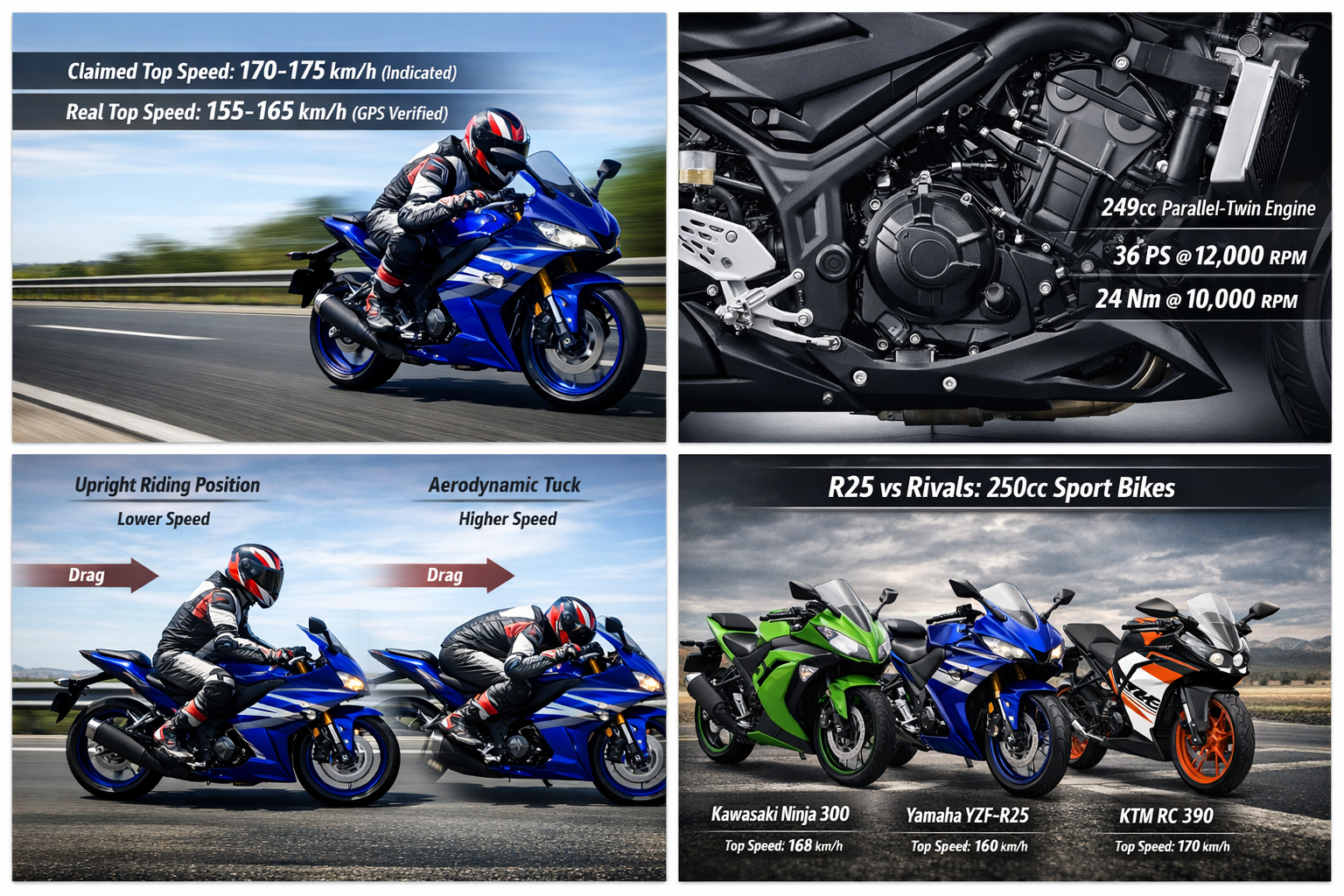
- Maximum power: ~35–36 PS @ around 12,000 rpm
- Maximum torque: ~23–24 Nm @ around 10,000 rpm
- Redline: Approximately 14,000 rpm
This high-revving nature plays a major role in the yamaha r25 top speed, as the bike thrives in the upper rpm range.
Official vs Real Yamaha R25 Top Speed
Claimed Yamaha R25 Top Speed
Manufacturers rarely publish an official top speed figure. However, based on factory gearing, engine output, and speedometer calibration, the claimed yamaha r25 top speed usually sits around:
170–175 km/h (indicated)
Real-World Yamaha YZF R25 Top Speed
In real riding conditions, GPS-verified and dyno-based testing typically shows:
155–165 km/h (true top speed)
The difference exists due to:
- Speedometer error (usually 5–8%)
- Wind resistance
- Rider weight
- Road gradient
- Environmental conditions
So when discussing yamaha yzf r25 top speed, it’s important to separate dashboard excitement from physical reality.
How Aerodynamics Shape Yamaha R25 Top Speed
At speeds above 120 km/h, aerodynamics matter more than raw horsepower.
The Yamaha R25 benefits from:
- A fully faired supersport body
- Aggressive front cowl inspired by the R1 and R6
- Narrow frontal area
These elements reduce drag and allow the engine to push the bike further at high rpm.
Rider Position and Tuck
A rider sitting upright can lose 8–12 km/h from the maximum yamaha r25 top speed. A proper racing tuck:
1. Reduces frontal drag
2. Helps the bike hit peak rpm in top gear
3. Improves stability near vmax
This is why professional testers often record higher yamaha yzf r25 top speed figures than casual riders.
Gearing and Transmission: Hidden Speed Influencers
The R25 uses a 6-speed gearbox with relatively short gearing in the lower gears and a longer sixth gear designed for cruising and top-end runs.
Top Gear Behavior
- Sixth gear is optimized for highway speeds
- The bike reaches top speed close to redline
- Power drop-off after peak rpm limits further acceleration
Unlike larger bikes, the R25 does not have surplus horsepower at the top end. This means:
- Any headwind can reduce top speed
2. Even slight inclines matter
This explains why yamaha r25 top speed on highway often differs from test track results.
Weight, Rider Load, and Yamaha R25 Top Speed
The Yamaha R25 weighs approximately 166 kg (wet). This relatively low weight helps acceleration but is less important at top speed.
Rider Weight Impact
- A heavier rider (90+ kg) may see 5–7 km/h reduction
- A lighter rider can more easily reach peak yamaha yzf r25 top speed
Passenger load dramatically reduces vmax due to increased drag and rolling resistance.
Road and Environmental Conditions
Even a perfect motorcycle cannot cheat physics.
Factors Affecting Yamaha R25 Top Speed
- Wind direction: Headwinds are speed killers
- Air density: Hot air reduces engine efficiency
- Road surface: Rough tarmac increases rolling resistance
- Altitude: Higher altitude reduces power output
Under ideal conditions cool weather, sea level, smooth road the yamaha r25 top speed reaches its maximum potential.
Comparison with Rivals
To contextualize the Yamaha R25 top speed, let’s compare it with competitors.
250cc Segment Comparison
- KTM RC 390: Higher torque, similar top speed
- Kawasaki Ninja 300: Slightly higher top end
- Honda CBR 250RR: Faster but significantly more expensive
The Yamaha YZF-R25 balances reliability and performance rather than chasing class-leading speed numbers.
Can You Increase Yamaha R25 Top Speed?
Yes—but within limits.
Common Modifications
- Performance air filter (minor gains)
- Free-flow exhaust (better mid-range, small top-end improvement)
- Sprocket changes (trade-off between acceleration and top speed)
However, aggressive gearing changes often reduce real-world usability. Yamaha engineers tuned the bike for balanced performance, not drag racing.
Mechanical Limits and Safety
- Chasing top speed endlessly stresses:
- Engine internals
- Cooling system
- Tires
- Brakes
The Yamaha R25 is happiest running near its designed limits, not beyond them. Long full-throttle runs should be done sparingly and with proper maintenance.
Final Verdict: Is Yamaha R25 Top Speed Enough?
The yamaha r25 top speed is not about dominating straight lines. It’s about:
- Smooth high-rpm performance
- Predictable power delivery
- Supersport feel without intimidation
With a real-world yamaha yzf r25 top speed of around 160 km/h, the bike offers more than enough performance for highways, twisty roads, and track days especially for riders upgrading from smaller machines.
Note:- The R25 proves that speed is not just a number; it’s a carefully engineered experience.
FAQs
The real yamaha r25 top speed is approximately 155–165 km/h when measured using GPS under ideal road and weather conditions. While the speedometer may show higher numbers, real-world testing accounts for wind resistance, rider weight, and road surface, giving a more accurate result
The yamaha yzf r25 top speed shown on the speedometer generally ranges between 170–175 km/h. This is an indicated speed and includes a built-in error margin, which is common in performance motorcycles for safety and compliance reasons.
In stock form, the Yamaha R25 cannot realistically reach 180 km/h. Achieving such a figure would require downhill terrain, strong tailwinds, or speedometer error. The mechanical and aerodynamic limits of the 250cc engine cap the true top speed well below that mark.
Yes, rider weight significantly affects the yamaha r25 top speed. A heavier rider increases rolling resistance and aerodynamic drag, which can reduce top speed by 5–10 km/h, especially on flat highways.
At maximum speed, the Yamaha R25 operates close to its redline of around 14,000 RPM in sixth gear. The engine delivers peak power near the upper RPM range, which is essential for reaching its maximum velocity.
Yes, the yamaha r25 top speed on highway conditions is more than sufficient for Indian and international highways. The bike can cruise comfortably at 120–130 km/h without engine strain, leaving enough headroom for overtakes.
Aerodynamics play a crucial role in determining the yamaha yzf r25 top speed. A proper racing tuck reduces wind drag significantly, allowing the bike to achieve higher speeds compared to an upright riding posture.
A free-flow exhaust may slightly improve throttle response and mid-range power, but the increase in yamaha r25 top speed is minimal unless combined with ECU tuning and intake modifications. Most gains are felt in acceleration rather than vmax.
The Kawasaki Ninja 300 has a marginally higher top speed due to its larger displacement, but the difference is small. The yamaha yzf r25 top speed remains competitive while offering smoother power delivery and better high-RPM stability.
Sustained top-speed riding increases wear on the engine, tires, and brakes. While the Yamaha R25 is engineered to handle high RPMs, prolonged vmax runs should be avoided without proper maintenance and safety gear.
Changing sprockets can alter gearing and slightly improve the yamaha r25 maximum speed, but this often comes at the cost of acceleration and everyday rideability. Improper gearing may also stress the engine.
Differences in rider posture, riding gear, weight, road gradient, wind conditions, and tire health all influence the yamaha r25 top speed, causing variations between individual test results.
In pure top-end performance, the KTM RC 390 may have a slight advantage due to higher torque. However, the Yamaha R25 delivers smoother power at high RPMs, making the yamaha yzf r25 top speed more consistent and predictable.
The ideal cruising speed for engine longevity and comfort is 110–130 km/h. At this range, the engine remains relaxed while still offering quick throttle response for overtakes.
Yes. Smooth, high-grip roads allow the motorcycle to roll more efficiently, helping achieve the best possible yamaha r25 top speed. Poor road surfaces increase friction and reduce overall speed.