
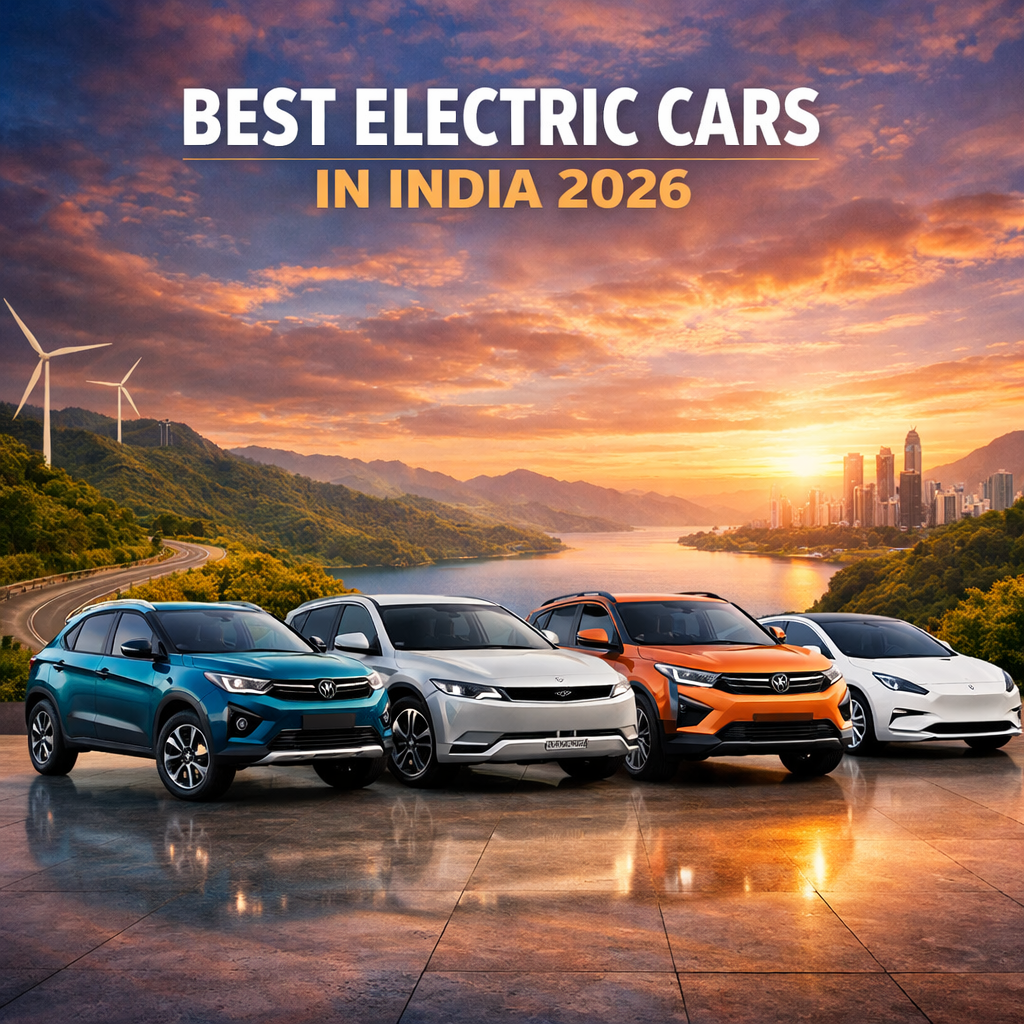
Best Electric Cars in India 2026: A Deep Dive into the Future of EV Mobility
The Indian motor industry is shifting to electricity much faster than ever before and the best electric cars in India 2026 is not only a craze but a tectonic plate shift in our relationship to mobility, cost and sustainability. As EVs (electric vehicles) fast become the standard and the list of exciting models grows, 2026 is set to be the year of success of electric cars buyers in India. India sources of affordable electric SUV and information on the cost of charging electric cars in India, electric cars maintenance cost, and battery life of the electric cars in India are some of the facts that are amassed in this guide to help both future shoppers and enthusiasts.
What Makes 2026 Special for EVs in India?
Indian EV market has developed fast. The increasing number of models in various price ranges with more powerful infrastructure backups are turning electric cars into more of a mainstream product. With reference to current automotive market directories India currently has more than 60 electric car models priced below [?]6 lakh up to the [?]70 lakh premium luxury models and a drastic contrast to the former years when EV selections were made in few.
Through schemes such as FAME II, government aids have also enhanced the speed in the availability of EVs and confidence among buyers. Still, infrastructure has certain loopholes, such as the current EV charging infrastructure in Delhi that is lower than needed, but something is being done to increase the number of public charging points along the urban corridors.
Top Contenders: Best Electric Cars in India 2026
Indeed, in case you want the best electric cars in India 2026, a brief description of the most prominent models of 2021 would be as follows:
1. Mahindra BE 6 – A strong SUV to anyone who wants to cover long distances as well as to enjoy a good performance at a fair price. It is 0.54 meters high, has a range of over 550 km on claimed, and it can be charged quickly, making it one of the serious competitors to the electric SUV in India. The prices begin in sub-[?]20 lakh segment and this may make it a competitive product in terms of balancing the capability with the value.
2. Tata Nexon EV – The Nexon EV is already one of the highest-selling electric SUVs in India, with a proven history of reliability and a practical range of more than 400km, interiors that are futuristic, and excellent after sales services. It continues to be kept popular into 2026 with its mix of practical applicability in the real world and reliability in the brand.
3. Tata Punch EV – One of the most visible new affordable electric SUV India models, the Punch EV is an SUV-style car with a lower price that most competitors. It is the right automobile to first-time EV buyers due to its ARAI-rated distance that comfortably meets the needs of driving in the city and to a growing number of chargers in metro areas.
4. MG Comet EV – In case you have the concentration on urban commuting and the hassle free ownership, the Comet EV will charm your interest with its small size and great affordability, a pattern on how the electric micro-car is currently almost becoming an ordinary car purchaser.
5. Mahindra XEV 9S and XEV 9e – These siblings SUVs are the first of the products that Mahindra is doing to venture in the higher-end EV segment as the two offer long-range options, advanced battery technology, and sophisticated packaging, specifications suited to those willing to spend a little more to get an upscale network experience.
In these models, what unites them is not only efficiency or style, but the concrete development of a system of full electric mobility that is no longer restricted to the early adopters, but it becomes a mass market.
Breaking Down Costs: Charging, Maintenance, and Batteries
Among the most commonly asked questions by EV purchasers is the question of costs: How much will it cost to charge? What about maintenance? How long do EV batteries last?
EV Charging Cost in India
The cost of charging may differ depending on the location and method of charging. The most cost-effective option is usually home charging:
- At residential electricity costs in India, home charging will be about ₹1–₹1.5 per km of travel, which is much less expensive than the cost of petrol or diesel driving, which may be ₹6–₹8 per km.
- Public fast chargers are characterized by a high price but provide utility in case of long journeys or tops ups.
The charging system is expanding, yet sustainability remains a matter of expansion ahead, particularly in the tier-2 and tier-3 cities in which infrastructure is still lagging.
Electric Car Maintenance Cost
Electric vehicles are engineered with fewer moving components than ICE (internal combustion engine) cars do not require oil changes, fewer fluids, and do not have complex drives. That would mean reduced annual bills of service:
- The price of the entry-level EVs such as the MG Comet EV and Tata Tiago EV could be as low as ₹3,000–₹4,500 per year in regular servicing due to the reduced number of mechanical complications.
- This cost per edge also applies to even the larger EV SUVs since most of the vehicles do not require as frequently servicing, and fewer parts replaced as compared to those powered by petrol or diesel.
Such simplicity is one of the fundamental strengths that various EV observers have highlighted as an element of one of the long term savings on ownership in India.
EV Battery Life in India
EV batteries form the core of the electric cars, and the awareness of the battery life in EV cars is essential to the purchasers:
- The majority of the manufacturers would offer battery warranties of between 8 years and 10 or even 1,60,000-2,00,000 km, that would guarantee peace of mind to the normal life span ownership.
- Battery life in practice can go well above warranty duration using reasonable thermal controls and moderate rates of charging.
These long support yields are comforting to mainstream customers because battery replacement is one of the most significant expenses that may be incurred in case of necessity upon warranty.
Final Thoughts: The Electrified Road Ahead
When we plot best electric cars in India 2026, it is evident that EV world is no longer a niche anymore: it is competitive, practical and getting cheaper. City-centric hatchbacks such as the MG Comet EV and crossovers such as the Tata Nexon EV and mid-range SUVs such as the Mahindra BE 6 fill the majority of the buyer requirements in India.
Ownership costs, as looked at in totality, such as EV charging cost in India, electric car maintenance cost and EV battery life India, is a strong argument that most car buyers can make electric. Electric cars are going to change personal transport in India by adding to it with government incentives, add to the charging infrastructure, and never ceasing innovation on the part of OEMs.
To know more visit here:- Facebook, Instagram, Twitter, YouTube
FAQ
1. Which are the best electric cars in India in 2026?
Some of the top electric cars in India in 2026 include models from Tata Motors, Mahindra, Hyundai, and MG Motor. Popular choices are expected to offer longer range, fast charging capability, improved battery efficiency, and enhanced connected features.
2. What is the average range of electric cars in India in 2026?
Most modern EVs in 2026 offer a real-world driving range between 300 km to 500 km on a single charge. Premium electric SUVs may exceed 500 km under ideal test conditions.
3. Which electric car offers the longest range in India?
High-end electric SUVs and premium EV sedans currently provide the highest range figures. Vehicles equipped with larger battery packs (60–80 kWh) typically deliver 450+ km certified range.
4. Are electric cars suitable for long-distance travel in India?
Yes. With the rapid expansion of public fast-charging networks across highways and metro cities, EVs are becoming increasingly practical for intercity travel. Planning charging stops in advance ensures a smooth journey.
5. What is the charging time for electric cars in 2026?
Charging time depends on charger type:
- Fast DC charger: 30–60 minutes (10% to 80%)
- Home AC charger: 6–8 hours (full charge)
Battery technology improvements in 2026 have significantly reduced fast-charging time.
6. Which is the most affordable electric car in India in 2026?
Entry-level EV hatchbacks from brands like Tata Motors remain among the most affordable electric cars in India, making EV ownership more accessible to middle-class buyers.
7. What are the maintenance costs of electric cars compared to petrol cars?
Electric vehicles generally have lower maintenance costs because they have fewer moving parts, no engine oil, no clutch, and reduced brake wear due to regenerative braking systems.
8. Are there government subsidies for electric cars in India in 2026?
Yes. Central and state governments continue to support EV adoption through incentives, road tax benefits, and registration fee exemptions under updated EV policies.
9. What is the battery warranty offered on electric cars?
Most manufacturers provide battery warranties ranging from 8 years or 1.6 lakh km, depending on the brand and model.
10. Should I buy an electric SUV in 2026?
If you prioritize fuel savings, low emissions, advanced technology, and smooth driving performance, an electric SUV in 2026 is a future-ready investment. However, consider your daily driving range, charging access, and budget before purchasing.